
Overview
Description
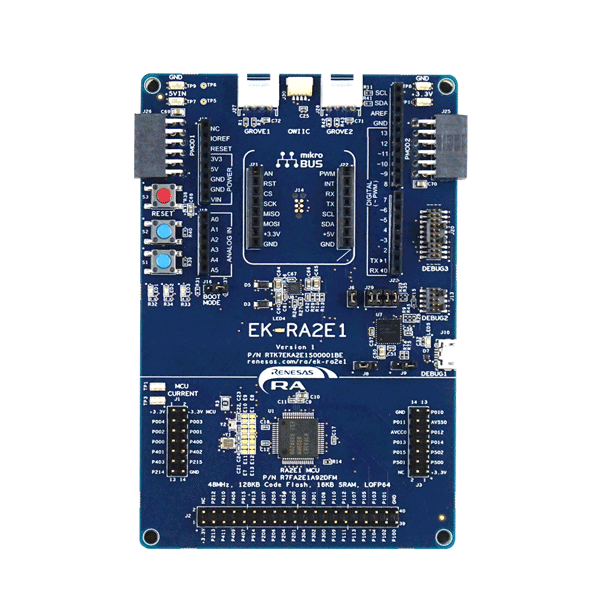
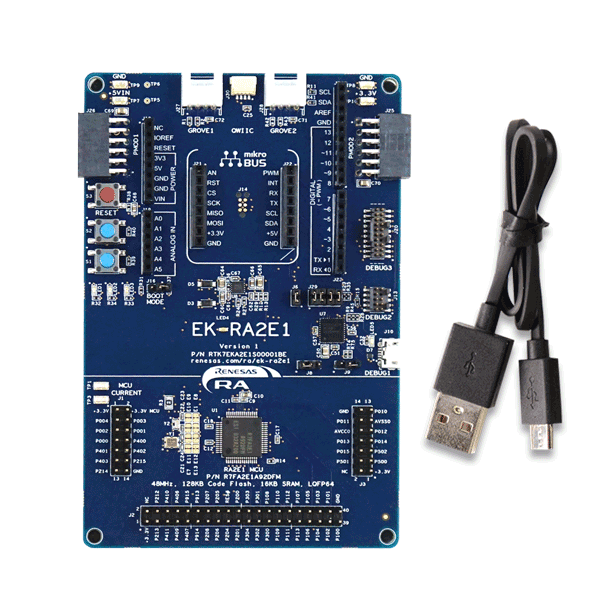
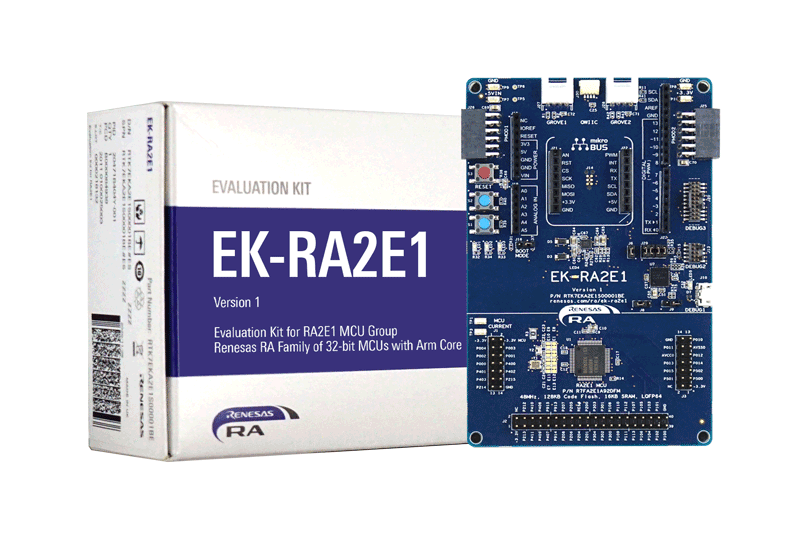
The EK-RA2E1 evaluation kit enables users to effortlessly evaluate the features of the RA2E1 MCU Group and develop embedded systems applications using Renesas' Flexible Software Package (FSP) and e2studio IDE. Utilize rich on-board features along with your choice of popular ecosystem add-ons to bring your big ideas to life. The kit includes the EK‑RA2E1 v1 board and a micro‑USB device cable (Type‑A male to micro‑B male).
Getting Started
Running the Quick Start Example Project
- The EK-RA2E1 board comes pre-programmed with a quick start example project (source code provided in the EK-RA2E1 example project bundle).
- Power up the EK-RA2E1 board through the USB debug port (J10) using the micro USB device cable connected to a 5V power source. The white power LED will light up.
- The quick start example project will begin to execute blinking the blue user LED.
- Refer to the EK-RA2E1 Quick Start Guide to explore additional functionality of the quick start example project.
Developing Embedded Applications
- Modifying the quick start example project – refer to the EK-RA2E1 Quick Start Guide for instructions on importing, modifying and building the quick start example project.
- Start with one of the many other example projects (provided in the EK-RA2E1 example project's bundle) – choose from many example projects to learn about different peripherals of the RA2E1 MCU group. These example projects can serve as excellent starting points for you to develop your custom applications.
Building Custom Hardware
- Start by building a functional prototype - utilize the EK-RA2E1 board with your choice of ecosystem add-ons.
- Build custom hardware – develop custom hardware by referring to the design and manufacturing information provided in the EK-RA2E1 design package.
Features
- MCU Native Pin Access
- R7FA2E1A92DFM MCU
- 48MHz, Arm Cortex®-M23 core
- 128KB Code Flash, 16KB SRAM
- 64-pin LQFP (10mm x 10mm x 1.7mm, 0.5mm pitch)
- Native pin access through prototype-friendly male headers
- MCU current measurement points
- Ecosystem & System Control Access
- Multiple 5V input sources
- USB (debug)
- External power supply
- SEGGER J-LinkTM on-board programmer and debugger
- Debug modes
- Debug on-board (SWD) – via J-Link
- Debug out (SWD) – via J-Link
- Debug in (ETM, SWD & JTAG) – via J-Link, Arm® Keil® ULINKTM, IAR I-jetTM, Renesas E2/E2 Lite, etc.
- User LEDs and buttons
- Three user LEDs (red, blue, green)
- Power LED (white) indicating availability of regulated power
- Debug LED (yellow) indicating the debug connection
- Two user buttons
- One reset button
- Five most popular ecosystem expansions
- MikroElektronika™ mikroBUS connector
- SparkFun® Qwiic® connector
- Two SeeedGrove® system (I2C and analog) connectors
- Two Digilent Pmod™ (SPI and UART) connectors
- Arduino™ (UNO R3) connector
- MCU boot configuration
- Multiple 5V input sources
Applications
Documentation
|
|
|
|
|---|---|---|
| Type | Title | Date |
| Quick Start Guide | PDF 1017 KB 日本語 | |
| Manual - Development Tools | PDF 3.30 MB 日本語 | |
| PCB Design Files | EK-RA2E1 v1 - Design Package
|
|
| Application Note |
PDF
1.67 MB
Learn how to use Arm CMSIS-DSP example projects that are ported to Renesas Arm Cortex-M33, Cortex-M85, and Cortex-M23 core-based MCUs with digital signal processing (DSP) extension and Floating Point Unit (FPU). Also learn the steps to import, configure, build, and execute these DSP examples and measure their performances.
|
|
| Application Note |
PDF
662 KB
The EK-RA2E1 example project shows how to write code for various Renesas Flexible Software Package (FSP) modules supported by the EK-RA2E1 kit. The Flexible Software Package provides an optimized, easy-to-use, scalable, and high-quality software solution for embedded system design.
|
|
| Application Note |
PDF
1.50 MB
AI-generated Summary:
Low Power Modes (LPMs) reduce power consumption in RA2L1/RA2E1 microcontrollers by stopping the CPU while allowing selective peripheral operation. Four LPM types include Sleep, Software Standby, Snooze, and Deep Software Standby modes, each with different power-saving levels and peripheral availability. The document covers configuring LPMs, clock source changes at runtime, peripheral operation during LPM, and user interface control for mode transitions. It also explains power control modes, timer configurations, and debugging techniques to optimize battery life in embedded applications.
|
|
| Application Note |
PDF
2.88 MB
AI-generated Summary:
The document explains how to implement a low-power data logger using RA2L1 and RA2E1 MCUs. It details the use of peripherals such as a 12-bit ADC, Data Transfer Controller, Asynchronous General-Purpose Timer, Real-Time Clock, and Event Link Controller to minimize power consumption. The system operates mainly in Software Standby and Snooze modes, performing periodic A/D conversions, level judgments, and data processing with minimal CPU activity. Data transmission occurs upon wakeup requests. The project uses Renesas e2 studio IDE and Flexible Software Package, supporting sensor inputs and analog signals. It targets applications like fitness and fleet trackers, demonstrating efficient low-power operation and data handling.
|
|
| Application Note |
PDF
2.60 MB
AI-generated Summary:
MCUboot provides a secure bootloader framework for 32-bit MCUs, enabling firmware integrity verification and secure updates. It supports multiple image upgrade methods—Overwrite, Swap, Direct execute-in-place (XIP), and RAM loading—each with distinct advantages and limitations. The RA2 MCU series uses MCUboot integrated with TinyCrypt for optimized cryptographic support, addressing limited memory constraints. The document guides creating and configuring bootloader projects, handling application updates, and running example projects on the EK-RA2E1 evaluation kit. It details development tools, hardware requirements, and best practices for secure bootloader deployment on Renesas RA2 MCUs.
|
|
| Flyer | PDF 412 KB | |
| Application Note | PDF 5.24 MB | |
| Presentation | PPS 22.14 MB | |
| Application Note |
PDF
9.38 MB
日本語
AI-generated Summary:
The document explains how to implement IO-Link communication using RA2E1 microcontroller and related hardware such as the EK-RA2E1 board, IA Sensor Network Connector Board, and ZSSC3240 Evaluation Board. It details the system configuration involving IO-Link master and device components, software tools including the IO-Link Device Tool V5.1, and the development environment. The content covers hardware setup, communication protocols, sample application flow, project execution, and device parameter management. It also includes instructions for modifying ZSSC settings and using USB-serial conversion for communication.
|
|
| Flyer | PDF 557 KB 日本語 | |
| Manual - Development Tools | PDF 456 KB 日本語 | |
| Report | PDF 187 KB 日本語 | |
15 items
|
||
Design & Development
Software & Tools
Software & Tools
| Software title
|
Software type
|
Company
|
|---|---|---|
| RA Flexible Software Package (FSP) FSP is an enhanced software package designed to provide easy-to-use, scalable, high-quality software for embedded system designs using Renesas RA Family of Arm Microcontrollers.
Note: FSP with e² studio Installer (Platform Installer) will install the e² studio tool, FSP packs, GCC toolchain, and Segger J-Link drivers required to use this software. No additional installations are required.
|
Software Package | Renesas |
| Renesas Flash Programmer (Programming GUI) Flash memory programming software [Support MCU/MPU and devices: RA, RE, RX, RL78, RH850, RISC-V MCU, Renesas Synergy, DA1453x, DA1459x, DA1469x, DA1470x, DA148xx, Power Management, Renesas USB Power Delivery Family, ICs for Motor Driver/Actuator Driver, V850, 78K0R, 78K0]
|
Programmer (Unit/SW) | Renesas |
| QuickConnect Platform QuickConnect platform enables fast prototyping by providing compatible hardware and software building blocks.
|
Software and Hardware Development Tools | Renesas |
3 items
|
||
Sample Code
Sample Code
Filters
|
||
|---|---|---|
| Type | Title | Date Date |
| Sample Code | RA Family Arm® DSP Examples
Learn how to use Arm CMSIS-DSP example projects that are ported to Renesas Arm Cortex-M33, Cortex-M85, and Cortex-M23 core-based MCUs with digital signal processing (DSP) extension and Floating Point Unit (FPU). Also learn the steps to import, configure, build, and execute these DSP examples and measure their performances.
|
|
| Sample Code | EK-RA2E1 Example Project Bundle
[Software=RA FSP],[Board=EK-RA2E1]
ZIP
6.16 MB
IDE:
e2 studio/GCC/AC6, IAR, Keil MDK
The EK-RA2E1 example project shows how to write code for various Renesas Flexible Software Package (FSP) modules supported by the EK-RA2E1 kit. The Flexible Software Package provides an optimized, easy-to-use, scalable, and high-quality software solution for embedded system design.
|
|
| Sample Code | LPM Application Package
|
|
| Sample Code | RA2L1/RA2E1 Group Example of Low Power Application (Data Logger) Rev.1.10 - Sample Code
|
|
| Sample Code | Secure Bootloader for RA2 MCU Series – Application Project - Sample Code
[Toolchains=GCC Arm Embedded|10.3.1.20210824] [Software=RA FSP] [Board=EK-RA2E1]
ZIP
15.03 MB
Compiler:
GNU Arm Embedded
IDE:
e2 studio
|
|
| Sample Code | Renesas RA Family Exception Handling
The application project uses the Flexible Software Package (FSP) of
the RA family|| the GNU GCC compiler|| and the integrated development environment e2 studio IDE to
demonstrate an exception handling flow for multiple possible faults.
ZIP
5.66 MB
Compiler:
GNU ARM Embedded
IDE:
e2 studio, Keil
|
|
| Sample Code | RA2E1 Group Examples of IO-Link Industrial Sensor Solutions
|
|
7 items
|
||
Related Boards & Kits
Boards & Kits

Evaluation Kit for RA2L1 MCU Group
The EK-RA2L1 evaluation kit enables users to effortlessly evaluate the features of the RA2L1 MCU Group and develop embedded systems applications using Renesas' Flexible Software Package (FSP) and e2 studio IDE. Utilize rich on-board features along with your choice of popular ecosystem add-ons to... Read More

Evaluation Kit for RA2A1 MCU Group
The EK-RA2A1 evaluation kit enables users to effortlessly evaluate the features of the RA2A1 MCU Group and develop embedded systems applications using Renesas' Flexible Software Package (FSP) and various IDEs.
Getting Started
Running the Quick Start Example Project
- The EK-RA2A1 board comes... Read More

Evaluation Kit for RA2E2 MCU Group
The EK-RA2E2 evaluation kit enables users to effortlessly evaluate the features of the RA2E2 MCU Group and develop embedded systems applications using Renesas' Flexible Software Package (FSP) and e2 studio IDE. Utilize rich on-board features along with your choice of popular ecosystem add-ons to... Read More

Smart Lock with AWS IoT Development Kit
The demand for smart locks is a rapidly growing segment for the home and building automation industries. This smart door lock solution features fingerprint control and low-power Wi-Fi, providing convenient fingerprint recognition, as well as on-site and remote lock open/close. The solution uses... Read More
Test This Board Remotely
Product Options
| Part Number | Status | Stock | Budgetary Price (USD) | Sampleable |
|---|---|---|---|---|
| RTK7EKA2E1S00001BE | Active | In Stock | 1u | $51.76 | Available |
Videos & Training
Kickstart IoT and embedded systems development using Renesas EK-RA2E1 and EK-RA2L1, Evaluation Kits for RA2E1 and RA2L1 MCU Groups. Familiarize yourself with the kit architecture, key features, quick start example project and many useful resources to begin innovating quickly.
Additional Videos
News & Blog Posts
Blog Post Mar 25, 2022 |
Blog Post Jan 28, 2022 |
Blog Post Jan 28, 2022 |
Blog Post Nov 18, 2021 |
Blog Post Nov 11, 2021 |
Certifications
The EK-RA2E1 kit meets the following certifications/standards. Refer to the EK-RA2E1 user manual for the disclaimer, precautions and more details on the certifications.
EMC/EMI Standards
- FCC Notice (Class A) – Part 15
- Innovation, Science and Economic Development Canada ICES-003 Compliance: CAN ICES-3 (A)/NMB-3(A)
- CE Class A (EMC Directive 2004/108/EEC)
- Taiwan Chinese National Standard 13438, C6357 compliance, Class A limits
- Australia/New Zealand AS/NZS CISPR 32:2015, Class A
Material Selection, Waste, Recycling, and Disposal Standards
- EU RoHS
- China SJ/T 113642014, 10-year environmental protection use period
Safety Standards
- UL 94V-0
Support
Support Communities
- EK-RA2E1 as SWD debugger
Try to use EK-RA2E1 as a SWD debugger , but it fails. Here is the connection to our target board: remove all the jumps for J29, J6, J8. J29 pin6 connect to target board SWDIO. J29 pin8 connect to target board SWCLK. J8 pin1 connect to target board Reset J8 ...
Mar 25, 2025 - EK-RA2E1 FreeRTOS
I found some problems when trying to use ek-ra2e1 to test my FreeRTOS project. I can't run two threads at the same time in my project. The purpose of my project is that the two lights are on and off, but I don't know why. It can ...
May 26, 2022 - RTC not working in Dev kit EK-RA2E1
Hi , I have modified example code to periodically interrupt for every 1 second. However I am not getting RTC interrupt . Following is the code snippet. /*******************************************************************************************************************//** * The RA Configuration tool generates main() and uses it to generate threads if an RTOS is used. This function is * called by ...
Jan 12, 2022
Knowledge Base
- Default XTAL Value Incorrect on EK-RA2E1
Last Updated:01/25/2021 In FSP 2.3.0, the default XTAL (ie: main clock oscillator) value when creating a project for the EK-RA2E1 is 16MHz. The EK-RA2E1 board actually has a 20MHz XTAL. Please note that the default clock source for EK-RA2E1 projects ...
Jan 25, 2021 - RA Family: How to use the Debug Out function of J-Link OB on EK (Evaluation Kit)
Last Updated: 12/14/2023 Question: How to use the Debug Out function of J-Link OB on EK (Evaluation Kit) Answer: Renesas has equipped each EK (Evaluation Kit) for RA MCUs, such as EK-RA2E1, EK-RA2E2, EK-RA2L1, EK-RA2A1, etcEK-RA4M1、EK-RA4M2、EK-RA4M3 ...
Dec 14, 2023

Support Communities


