

Governance
Governance | Risk Management | Ethics and Compliance | Information Security | Executive Compensation | Tax Policy
Executive Compensation
(i) Compensation for Directors
<Directors who concurrently serve as Executive Officers>
Compensation for Directors who serve concurrently as Executive Officers is described in “(ii) Compensation for Executive Officers/Executive Corporate Officers” below.
<Directors who do not concurrently serve as Executive Officers>
For Directors who do not concurrently serve as Executive Officers, in accordance with the basic policy set forth below, the Company pays base salary as fixed compensation and grants stock-based compensation (stock-based compensation where shares are delivered after a certain period of continuous service) (Restricted Stock Units (RSUs)) from the perspective of aligning with long‑term interests of shareholders. The details of such stock-based compensation are described in “(ii) Compensation for Executive Officers/Executive Corporate Officers, (b) Composition of Compensation, (2) Stock-based Compensation” below.
- Contribute to recruiting and retaining global talent for Director positions that meet the capability requirements necessary for the appropriate oversight of the Company’s management.
- Ensure a high level of transparency and objectivity.
- Ensure that compensation is linked to the enhancement of corporate value and aligned with shareholders’ interests.
The compensation amount and composition for each Director who does not concurrently serve as an Executive Officer are determined by the Compensation Committee based on the above basic policy. In making these determinations, the Compensation Committee refers to market data from Japan and the United States (In Japan, the levels and trends of the top 100 companies by market capitalization, as well as companies within the top 100 that have a mix of Directors who are residents and non‑residents of Japan. In the United States, this includes the levels and trends of S&P 500 companies, as well as those within the S&P 500 that belong to the IT sector.).
(ii) Compensation for Executive Officers/Executive Corporate Officers
This section describes the compensation program for our Executive Officers and Executive Corporate Officers. The composition of our Executive Officers and Executive Corporate Officers as of December 31, 2025 is as follows. An Executive Officer who also serves as a Director is compensated in their capacity as an Executive Officer.
| Name | Position and responsibilities | Executive Officer | Executive Corporate Officer |
|---|---|---|---|
| Hidetoshi Shibata | Director, Representative Executive Officer, President and CEO | ✓ | - |
| Shuhei Shinkai | Senior Vice President and CFO, in charge of matters relating to Finance, Business Development, Accounting & Control, Investor Relations, Information Systems | - | ✓ |
| Utae Nakanishi | Senior Vice President and CHRO, in charge of matters relating to Human Resources and General Affairs | - | ✓ |
| Yuya Hasegawa | Senior Vice President and CSO, in charge of matters relating to Sales | - | ✓ |
| Davin Lee | Senior Vice President, in charge of matters relating to Analog & Connectivity, and Embedded Processing | - | ✓ |
| Vivek Bhan | Senior Vice President, in charge of matters relating to High Performance Computing | - | ✓ |
| Zaher Baidas | Senior Vice President, in charge of matters relating to Power | - | ✓ |
| Aram Mirkazemi | Senior Vice President, in charge of matters relating to Software & Digitalization | - | ✓ |
| Julie Pope | Senior Vice President, in charge of Strategic Initiatives & User Experience | - | ✓ |
| Takeshi Kataoka | Senior Vice President, in charge of matters relating to Operations (including Supply Chain, Procurement and Manufacturing), Quality Assurance | - | ✓ |
Executive Officers and Executive Corporate Officers of the Company have broad responsibilities for the overall operation of the organization and our businesses in accordance with their respective roles, and each is accountable for our business performance and long term growth.
Accordingly, the Company aims to ensure transparency in its disclosures regarding executive compensation not only for the Executive Officer who concurrently serves as CEO, but also for the core members of the management team. Therefore, the Company discloses the individual compensation of CFO and the next three highest compensated Executive Corporate Officers (i.e., Senior Vice President responsible for Software & Digitalization Group, Senior Vice President responsible for High Performance Computing Product Group, and Senior Vice President responsible for the Analog & Connectivity Product Group and Embedded Processing Product Group), without limiting to the compensation of Directors and Executive Officers whose total compensation meets or exceeds 100 million yen, as required by law.
(a) Basic Policy
The Company views compensation as one of the key management tools for succeeding in intensely competitive and rapidly evolving global markets and for accelerating long term business growth, and therefore continuously updates its compensation program for Executive Officers and Executive Corporate Officers.
In determining the compensation of Executive Officers and Executive Corporate Officers, the Company takes into account, as fundamental considerations, the significance and complexity of the roles and responsibilities expected of each such officer in relation to the Company’s long-term business growth, as well as each individual’s demonstrated track record evidencing the anticipated level of contribution and capability.
Consistent with the principle of “Pay for Performance” and from the standpoint of ensuring that Executive Officers and Executive Corporate Officers are held accountable for enhancing the Company’s performance and corporate value, a substantial portion of each officer’s annual compensation is delivered as performance linked compensation in the form of Short Term Incentives (STIs) and as stock compensation in the form of Long Term Incentives (LTIs). STIs are designed to reflect the Company’s short term performance, while LTIs are intended to align compensation with the Company’s long term corporate value creation, as reflected in its stock price. LTIs consist of Performance Share Units (PSUs), the vesting amount of which varies based on the Company’s total shareholder return (TSR), and Restricted Stock Units (RSUs), which are subject to continued service conditions. The Company has been progressively increasing the proportion of PSUs within the LTI mix.
Furthermore, in light of the requirement that the Company’s management team possess the capabilities necessary to compete successfully on a global stage, and recognizing the need to attract and retain highly talented individuals through a competitive compensation program, the Company references the compensation programs, market levels, and prevailing trends of companies in the United States and Japan that exhibit a high degree of relevance to the Company when designing its compensation program and determining appropriate compensation levels. The composition of such reference companies is regularly reviewed and assessed by the Compensation Committee, taking into account the Company’s business strategy and the specific circumstances of each peer company.
In addition, as the Company’s organizational structure, including the composition of its executive leadership, continues to become increasingly global, and given that it would be undesirable to maintain materially different compensation levels across regions for management talent who lead such an integrated organization, the Company has adopted a policy of narrowing regional executive compensation disparities to a reasonable range and is currently progressing through the transition phase of its implementation.
(b) Composition of Compensation
The Company's current compensation program consists of the following elements, which are based on the foregoing basic policy. The specific details of each element are set out in the subsections that follow.
- Base salary as fixed compensation (cash compensation)
- Performance‑linked compensation, in the form of Short‑Term Incentives (STIs), focused on achieving short‑term performance objectives (cash compensation)
- Stock compensation, in the form of Long‑Term Incentives (LTIs), tied to long‑term corporate value creation (post‑delivery stock‑based compensation)
(1) Cash Compensation
Base Salary
Base salary constitutes the core element of compensation, reflecting the assessed roles and responsibilities of each position within the organization. It is paid as a fixed amount and is determined based on fundamental considerations, including the roles and responsibilities, capabilities, and experience of each Executive Officer and Executive Corporate Officer.
This component serves as a foundational element of the Company’s executive compensation program and is set at an appropriate level to attract and retain highly qualified Executive Officers and Executive Corporate Officers, as well as to incentivize them to drive the Company’s growth in the global market.
Performance-linked Compensation (Short-Term Incentive (STI))
Short‑Term Incentives (STIs) are paid to Executive Officers and Executive Corporate Officers as a means to incentivise and reward both the Company’s overall financial performance and the individual performance of each officer during the relevant fiscal year. This component is a critical element of the Company’s executive compensation program and is designed to incentivise Executive Officers and Executive Corporate Officers to contribute to the achievement of performance objectives by linking payout amounts to Company‑wide results as well as individual performance.
To appropriately reflect business growth and its profitability, STI payout amounts are evaluated using certain non‑GAAP performance indicators, including the following:
- Revenue
- Operating margin
Evaluation indicators and targets are established annually. The payout amounts based on business performance are approved by the Compensation Committee, taking into account factors such as the degree of achievement against the targets for each evaluation indicator and the individual performance of each Executive Officer and Executive Corporate Officer for the relevant fiscal year.
This compensation scheme is aligned with that applicable to employees and is designed to ensure that the incentives of Executive Officers and Executive Corporate Officers are consistent with those of employees.
(2) Stock-based Compensation
Stock Compensation (Long-Term Incentive (LTI))
Long‑Term Incentives (LTIs) constitute variable compensation with an evaluation period of one year or longer and are generally granted in a manner that corresponds to the value created for shareholders. The purpose of LTIs is to align the economic interests of Executive Officers and Executive Corporate Officers with the Company’s long‑term performance and the long‑term interests of its shareholders.
Since 2021, LTIs have been granted through stock‑based compensation under which shares are delivered following vesting, and the actual value realized by Executive Officers and Executive Corporate Officers is determined based on stock price growth and/or total shareholder return (TSR) over a three‑year period.
LTIs consist of Performance Share Units (PSUs), under which the number of units delivered varies based on the Company’s TSR performance, and Restricted Stock Units (RSUs), which are subject to continued service requirements. PSUs incorporate the Company’s TSR as the performance metric in order to strengthen incentives and reinforce accountability for maximizing long‑term corporate value and contributing to stock price performance.
The number of units to be granted is determined based on the base compensation amount set for each Executive Officer and Executive Corporate Officer, using the simple average of the closing price of the Company’s shares on the Tokyo Stock Exchange during the three‑month period specified at the time the grant decision is made. The proportion of the base compensation amounts for PSUs and RSUs is 70%:30% for the CEO (Executive Officer), and 50%:50% for Executive Corporate Officers.
If a grantee becomes subject to any of the circumstances stipulated by the Company, such as certain forms of misconduct, some or all of the unvested units shall be forfeited. In addition, if, after vesting, it is determined that such circumstances or the underlying conduct occurred prior to vesting and the Company deems it necessary, the grantee shall be required to return, without compensation, all or part of the shares delivered in respect of such units, or an equivalent monetary amount.
| Type | Purpose | Basis | Composition Ratio | |
|---|---|---|---|---|
| CEO | Executive Corporate Officers | |||
| Performance Share Units (PSUs) | Strengthen Executive Officers’ and Executive Corporate Officers’ incentives to contribute to sustained stock price appreciation and long‑term corporate value enhancement | TSR | 70% | 50% |
| Restricted Stock Units (RSUs) | Recruit and retain outstanding talent by reinforcing the linkage between compensation and stock price and by sharing value creation with shareholders | Tenure | 30% | 50% |
(Note) The composition ratios are based on the base compensation amounts established for 2025.
[PSU]
The number of units to be granted to the grantees shall be calculated based on the following formula:
Number of PSUs = PSU base compensation amount (before performance evaluation) which the Company has determined to grant to each grantee / simple average of the closing price of our shares on the Tokyo Stock Exchange for the 3-month period specified at the time of grant decision.
Following the date determined by the Company (in principle, the third anniversary of the grant date), the Company will issue a number of shares equivalent to the vested units, as determined in accordance with the performance requirements for the applicable period.
| Performance Indicators | TSR: Determined by comparing the Company’s total shareholder return against the companies that constitute SOX (Philadelphia Semiconductor Index) and TOPIX (Tokyo Stock Price Index), as well as a group of companies selected by the Company (referred to as the “Renesas Peers”) selected based on factors such as industry, company size, and business model. | ||||||||||||
| Performance Evaluation Period | 3 years from April 1 of the year in which PSUs were granted | ||||||||||||
| TSR Growth Rate of the Company | (Average stock price for the 3 months prior to the end of the performance evaluation period (*1) Image 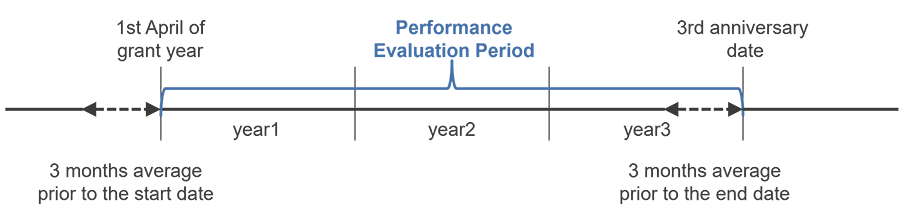 | ||||||||||||
| Method of Determining Issued Shares |
|
[RSU]
The number of units to be granted to each grantee shall be calculated in accordance with the following formula:
Number of RSUs = RSU base compensation amount for the 3 years (however, for Outside Directors, 1 year) that the Company decided to grant to each grantee / the simple average of the closing price of our shares on the Tokyo Stock Exchange during the 3-month period specified at the time of grant decision.
As a general rule, one third of the units vest each year following the grant date (provided, however, that for Outside Directors, all units vest one year after the grant date). The Company will issue a number of shares equal to the number of vested units.
(3) Reference Company Groups (for FY2025 Compensation Decisions)
Based on the basic policy described above, the Compensation Committee referred to the following groups of companies when determining compensation for Executive Officers and Executive Corporate Officers for FY2025.
For the reference companies in the United States, the Compensation Committee selected 16 companies in the semiconductor and IT sectors with a high degree of correlation with the Company as the primary reference group. In addition, software companies were selected as a secondary reference group to reflect the acquisition of Altium and the advancement of the Company’s digitalization strategy.
For the reference companies in Japan, the Compensation Committee selected 42 companies as the primary reference group from among the top 100 companies by market capitalization, excluding those in sectors with low correlation to the Company or those with low overseas sales ratios. A secondary reference group was also selected, consisting of companies considered to have a high degree of similarity to the Company’s business strategy.
In referencing these company groups, the Company supplemented the individual compensation data disclosed by the reference companies with external market compensation survey data provided by WTW (Towers Watson), Mercer LLC, and Aon.
| US Primary Reference Group (16 companies) | Japan Primary Reference Group (42 companies) | |
|---|---|---|
| Advanced Micro Devices, Inc. Analog Devices, Inc. Broadcom Inc. Corning Incorporated Marvell Technology, Inc. Microchip Technology Incorporated Micron Technology, Inc. Motorola Solutions, Inc. NetApp, Inc. ON Semiconductor Corporation Qorvo, Inc. QUALCOMM Incorporated Roper Technologies, Inc. Skyworks Solutions, Inc. Texas Instruments Incorporated Western Digital Corporation | Toyota Motor Corporation Sony Group Corporation Tokyo Electron Limited Hitachi, Ltd. Recruit Holdings Co., Ltd. Mitsubishi Corporation Chugai Pharmaceutical Co., Ltd. Mitsui & Co., Ltd. Daiichi Sankyo Company, Limited Honda Motor Co., Ltd. Daikin Industries, Ltd. DENSO Corporation Takeda Pharmaceutical Company Limited HOYA Corporation Murata Manufacturing Co., Ltd. Seven & i Holdings Co., Ltd. Mitsubishi Electric Corporation Fujitsu Limited Bridgestone Corporation Fanuc Corporation Disco Corporation | Sumitomo Corporation Marubeni Corporation Canon Inc. Toyota Industries Corporation Advantest Corporation Komatsu Ltd. Terumo Corporation Panasonic Holdings Corporation Astellas Pharma Inc. Kyocera Corporation Kao Corporation Nippon Paint Holdings Co., Ltd. TDK Corporation Kubota Corporation Olympus Corporation Nissan Motor Co., Ltd. Eisai Co., Ltd. Shimano Inc. Subaru Corporation BANDAI NAMCO Holdings Inc. Shiseido Company, Limited |
(iii) Content of compensation for Directors, Executive Officers, and Executive Corporate Officers for the current fiscal year, and the reasons why the Compensation Committee has determined that such compensation is consistent with the policy for determining the compensation of each Director, Executive Officer, and Executive Corporate Officer
(a) Review by the Compensation Committee
The details and calculation basis of the compensation for Directors, Executive Officers and Executive Corporate Officers for the current fiscal year are described in “(b) Compensation for the Current Fiscal Year” below.
In making the final determination of such compensation, the Compensation Committee reviewed whether the overall compensation package, as well as each component thereof, was appropriate and aligned with the basic policies described above. The specific items reviewed included the total compensation amount (base salary, STI, and stock‑based compensation), the cash compensation amounts (base salary and STI), the stock‑based compensation amounts (PSUs and RSUs), the proportion of each compensation element (particularly the ratio of base salary to STI and stock‑based compensation, and the ratio of PSUs to RSUs), and the design of incentive structures (including STI evaluation indicators and targets, and the overall effectiveness of the compensation framework).
Based on these comprehensive reviews, the Compensation Committee concluded that the levels and composition of compensation for the current fiscal year were consistent with the basic policies and were appropriate.
(b) Compensation for the Current Fiscal Year
(1) Total compensation amount for Directors and Executive Officers
| Title | Headcount | Total Compensation (Millions of yen) | Total Amount of Compensation by Type (Millions of yen) | |||
|---|---|---|---|---|---|---|
| Cash Compensation | Non-cash Compensation | |||||
| Base Salary | Performance-linked Compensation (Short-Term Incentives: STI) | Long-Term Incentives | ||||
| Stock Compensation with Stock Price-linked Conditions (PSU) | Stock Compensation with Continuous Service Conditions (RSU) | |||||
| Directors | 5 | 102 | 84 | - | - | 18 |
| Executive Officers | 1 | 873 | 113 | 145 | 311 | 304 |
(Note)
- The “Directors” in the table are all Outside Directors and do not include one Director who concurrently serves as an Executive Officer. Executive Officer who concurrently serves as Director receives compensation as an Executive Officer and is shown in the “Executive Officers” column.
- Amounts are rounded to the nearest million yen. Therefore, the total amount listed in each column may not match the amount stated in the Total Compensation column.
- “Stock Compensation with Stock Price-linked Conditions (PSU)” and “Stock Compensation with Continuous Service Conditions (RSU)” in the table represent the fair value calculated based on the closing price of stock on the date of vesting for which the rights were vested during the current fiscal year. In addition, the amounts recorded as expenses for accounting purposes for the current fiscal year are 30 million yen for Directors and 1,199 million yen for Executive Officer.
- For Directors and Executive Officers who do not reside in Japan, the currency for payment is converted into Japanese yen at the average exchange rate during the current fiscal year (JPY149.53 = USD 1.00).
(2) Total Amount of Consolidated Compensation for each Executive Officer and Executive Corporate Officer Subject to Disclosure
(α) Total Amount of Cash Compensation Paid and Stock-based Compensation Vested in the Current Fiscal Year
| Name | Amount of Compensation (Millions of yen) | Total Compensation (Millions of yen) | |||
|---|---|---|---|---|---|
| Base salary | Performance-linked Compensation | Stock Compensation | |||
| Long-Term Incentives (LTI) | |||||
| Short-term Incentive (STI) | Stock Compensation with Stock Price-linked Conditions (PSU) | Stock Compensation with Continuous Service Conditions (RSU) | |||
| Hidetoshi Shibata | 113 | 145 | 311 | 304 | 873 |
| Shuhei Shinkai | 40 | 37 | 72 | 63 | 212 |
| Aram Mirkazemi | 75 | 57 | 12 | 0 | 144 |
| Vivek Bhan | 87 | 67 | 196 | 224 | 574 |
| Davin Lee | 75 | 57 | 144 | 141 | 417 |
(Note)
- Amounts are rounded to the nearest million yen. Therefore, the total of the amounts listed in each column may not match the amount in the Total Compensation column.
- “Base salary” represents the amount paid in the current fiscal year. “Performance-linked Compensation” represents the amount of Short-Term Incentives (STI) payments using the current fiscal year as evaluation period. “Stock Compensation” represents the amount vested in the current fiscal year.
- For overseas officers, the currency for payment is converted into Japanese yen at the average exchange rate during the current fiscal year (JPY149.53 = USD 1.00).
(β) Total Amount of Target Compensation (Base Salary, Target Short-Term Incentives (STI), and Base Compensation Amounts of Stock-based Compensation) in the Current Fiscal Year
| Name | Amount of Compensation (Millions of yen) | Total Compensation (Millions of yen) | |||
|---|---|---|---|---|---|
| Base salary | Performance-linked Compensation | Stock Compensation | |||
| Long-Term Incentives (LTI) | |||||
| Short-term Incentive (STI) | Stock Compensation with Stock Price-linked Conditions (PSU) | Stock Compensation with Continuous Service Conditions (RSU) | |||
| Hidetoshi Shibata | 113 | 143 | 1,697 | 727 | 2,679 |
| Shuhei Shinkai | 40 | 36 | 193 | 193 | 463 |
| Aram Mirkazemi | 75 | 56 | 187 | 187 | 505 |
| Vivek Bhan | 87 | 65 | 172 | 172 | 496 |
| Davin Lee | 75 | 56 | 172 | 172 | 475 |
(Note)
- Amounts are rounded to the nearest million yen. Therefore, the total of the amounts listed in each column may not match the amount in the Total Compensation column.
- In the table, STI amounts represent each individual’s target STI before performance adjustment, and the PSU and RSU amounts represent, respectively, each individual’s annual base compensation amount for each type of stock-based compensation (Amounts are rounded to the nearest million yen.)
- For overseas officers, the currency for payment is converted into Japanese yen at the average exchange rate during the current fiscal year (JPY149.53 = USD 1.00).
(γ) Composition Ratios of Each Compensation Element for Executive Officers and Executive Corporate Officers Subject to Disclosure (Based on Target STI Amounts and the Base Compensation Amounts of Stock‑based Compensation)
As shown in the graph below, and consistent with the Company’s emphasis on the “Pay for Performance” policy, the proportion of variable compensation—comprising Short Term Incentives (STI) and stock based compensation (PSUs and RSUs)—is higher than the general level of executive compensation typically observed in Japan.
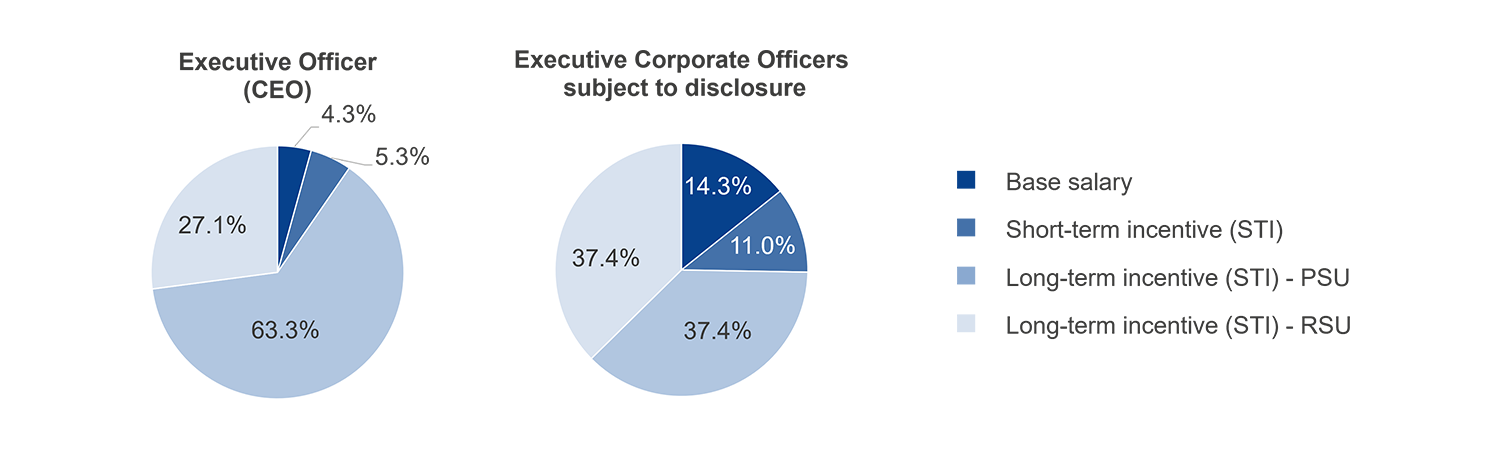
(Note) Among the compensation elements, STI is calculated based on the target STI amount before performance adjustment, and LTIs are calculated based on the annual base compensation amounts of stock based compensation granted in FY2025.
(δ) Actual Results Used to Calculate the Payout Amounts of Performance linked Compensation (STI) and the Vested Amounts of Stock Compensation with Stock price linked Conditions (PSU) and Stock Compensation with Continued service Conditions (RSU)
Both revenue (Non GAAP basis) and operating margin (Non GAAP basis) for the current fiscal year decreased. The three year average total shareholder return (TSR) growth was 74.2%, exceeding the median levels of the TOPIX constituent companies, the SOX constituent companies, and the Renesas Peers.
Performance-linked Compensation (STI):
Revenue (Non-GAAP basis)
- Our revenue decreased by 2.2% in the current fiscal year compared with the previous fiscal year.
- Revenue by business segment is as follows:
- Revenue in the Automotive Segment in the current fiscal year decreased by 9.0% compared with the previous fiscal year.
- Revenue in the Industrial/Infrastructure/IoT Segment in the current fiscal year increased by 5.5% compared with the previous fiscal year.
Operating margin (Non-GAAP basis)
- Our operating margin in the current fiscal year decreased by 0.2 pts compared with the previous fiscal year.
- Operating margin by business segment is as follows:
- Operating margin in the Automotive Segment in the current fiscal year decreased by 0.9 pts compared with the previous fiscal year.
- Operating margin in the Industrial/Infrastructure/IoT Segment in the current fiscal year decreased by 2.0 pts compared with the previous fiscal year.
Stock Compensation with Stock Price-linked Conditions (PSU):
Total Shareholder Return (TSR)
- The TSR growth rate used to evaluate performance in the PSU vesting process in the current fiscal year was 74.2%, higher than the median of TOPIX constituent companies, the median of SOX-constituent companies, and the median of Renesas Peers.
- Payout% based on the TSR is as follows.
| TSR | Group | %ile Max: 90%ile or above Target: 50%ile Min: less than 25%ile | Payout% Max: 200% Target: 100% Min: 0% | Weight | Final Payout% Vs PSU base amount Max: 200% Target: 100% Min: 0% |
|---|---|---|---|---|---|
| 74.2% | TOPIX | 72.2%ile | 144.4% | 50% | 166.2% |
| SOX | 82.8%ile | 176.0% | 25% | ||
| Renesas Peers (Group 1) | 93.8%ile | 200.0% | 12.5% | ||
| Renesas Peers (Group 2) | 100.0%ile | 200.0% | 12.5% |
(Note) For Renesas Peers, we evaluated performance by dividing them into 2 groups based on factors including industry and company size.
Overview of performance results
| 1 year | 3 years | ||
|---|---|---|---|
| Revenue (Non-GAAP basis) | -2.2% | ||
| Automotive Segment | -9.0% | ||
| Industrial/Infrastructure/IoT Segment | +5.5% | ||
| Operating margin (Non-GAAP basis) | -0.2pt | ||
| Automotive Segment | -0.9pt | ||
| Industrial/Infrastructure/IoT Segment | -2.0pts | ||
| Total Shareholder Return (TSR) | +74.2% | ||
(Note)
- Revenue and Operating Margin: Disclosed on a Group-consolidated and Non-GAAP basis
- TSR performance evaluation period: April 1, 2022 to March 31, 2025
- TSR calculation: (Average stock price for the 3 months prior to the end of the performance evaluation period
- Average stock price for the 3 months prior to the commencement date of the performance evaluation period
+ Total dividends per share for dividends from retained earnings with a record date during the performance evaluation period)
/ Average stock price for the 3 months prior to the commencement date of the performance evaluation period - The Company paid dividends totally 56 JPY per share from retained earnings during the performance evaluation period.
Stock Compensation with Continuous Service Conditions (RSU):
Share price trends
- Upon vesting, RSUs are settled through the delivery of a number of shares of the Company’s common stock equal to the number of vested units. Accordingly, the value of vested RSUs is calculated based on the number of units granted—which is determined at the time of grant using the formula below—and factors such as the closing price of the Company’s shares on the Tokyo Stock Exchange at the time of vesting.
Number of RSUs = RSU base compensation amount for the three-year period (or one year, in the case of Outside Directors) / the simple average of the closing prices of the Company’s shares on the Tokyo Stock Exchange during the three-month period specified at the time the grant decision is made. - RSUs vest in equal installments of one‑third each year upon the lapse of each year following the grant date; provided, however, that for Outside Directors, all RSUs vest in full on the first anniversary of the grant date.
- Because the timing of appointment, the number of RSUs granted in the past, and the grant dates differ among Executive Officers and Executive Corporate Officers, individual calculations are complex. However, for reference, an overview of the Company’s share price fluctuations since fiscal year 2022 is set out below.
| Fiscal Year | Open | High | Low | Close |
|---|---|---|---|---|
| 2022 | 1,435 | 1,561 | 1,145 | 1,184 |
| 2023 | 1,173 | 2,900 | 1,166 | 2,549 |
| 2024 | 2,454 | 3,397 | 1,821 | 2,047 |
| 2025 | 2,042 | 2,750 | 1,320 | 2,140 |
(Note) Figures in the table above are rounded to the nearest yen.
(iv) Benefits and Welfare
Executive Officers and Executive Corporate Officers are eligible to receive various benefits equivalent to those provided to the Company’s other employees, excluding severance benefits. Such benefits include social insurance coverage (health insurance and welfare pensions), accident insurance, commuting expense reimbursement, and eligibility to participate in group insurance programs.
(v) Pay Ratio (Compensation Ratio)
The median of total annual compensation of all employees (other than the CEO) for our current fiscal year was 6.3 million yen. The CEO’s total annual compensation was 873 million yen. Based on this information, the ratio of the CEO’s total annual compensation to the median of total annual compensation of all employees was approximately 139 to 1.
The following methodologies and material assumptions were used to determine the median of total annual compensation of all our employees and to calculate the total annual compensation of the median employee:
- December 31, 2025 was selected as the date (record date) for determining the median employee.
- As of the record date, the Company had approximately 21,000 employees working for the Company and its consolidated subsidiaries. Employees on leave who were not expected to return to work and employees of Altium and Transphorm were excluded because their compensation structures had not yet been integrated into the Company’s compensation framework.
- To identify the median employee, the Company used information relating to base salaries and incentive payments for all employees. Monthly salaries were annualized for full time employees who had a service period of less than one fiscal year or who had taken an unpaid leave of absence during the one year period.
The CEO’s total annual compensation is the amount shown in the section titled “(iii) Content of compensation for Directors, Executive Officers, and Executive Corporate Officers for the current fiscal year, and the reasons why the Compensation Committee has determined that such compensation is consistent with the policy for determining the compensation of each Director, Executive Officer, and Executive Corporate Officer, (b) Compensation for the current fiscal year, (2) Total Amount of Consolidated Compensation for each Executive Officer and Executive Corporate Officer Subject to Disclosure, (α) Total Amount of Cash Compensation Paid and Stock-based Compensation Vested in the Current Fiscal Year” above.
(vi) Compensation Committee
As a Company with Nomination Committee, etc., in order to ensure the appropriateness of compensation and the transparency of the decision making process, the Company has established a Compensation Committee, which is composed of a majority of Outside Directors and is chaired by an Outside Director. The members of the Compensation Committee are as follows.
- Chairperson: Selena Loh Lacroix (Outside Director)
- Member: Noboru Yamamoto (Outside Director)
- Member: Tomoko Mizuno (Outside Director)
- Member: Hidetoshi Shibata (Director, Representative Executive Officer, President and CEO)
A total of four meetings of the Compensation Committee were held during the current fiscal year. The compensation levels and compensation structure, including target setting for performance‑linked compensation, the level and design of stock‑based compensation, and the selection of reference company groups, for Directors, Executive Officers and Executive Corporate Officers were determined by the Compensation Committee, taking into consideration advice from the Company’s compensation advisor, WTW (Towers Watson), briefing sessions with the advisor, and market data and other relevant information. However, Hidetoshi Shibata, Representative Executive Officer, President and CEO, did not participate in the decision making regarding his own compensation.